Two Man Time Trial Race – 26.4 miles
http://ridewithgps.com/trips/3753707
We averaged 20.9 mph, taking third place in our age group in the road bike class.
We may not be as fast as Lance Armstrong, but it doesn’t matter because we have a ton of fun doing the Tour de Gruene two man time trial race. Yes, we do take performance enhancing substances to impede our performance, including chocolate chip cookies, brownies, ice cream and apple pie. I have overdosed on brownies many times and I am still addicted to them today; I plan to remain addicted well into the future.
Background
For more than 30 years, the Tour de Gruene has been well known to cyclists for its fun tour ride through the Canyon Lake hill country and for its single man and two man time trial races. The races are for both pros and amateurs. Lance Armstrong has done the Tour de Gruene three times and was scheduled to race this year, but his teammate had to drop out at the last minute Link to article. Here are pictures of Lance from the 2008 Tour de Gruene.
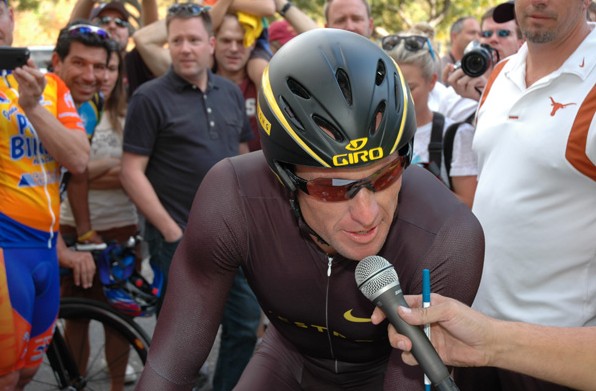
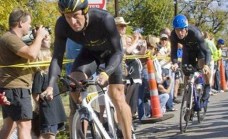
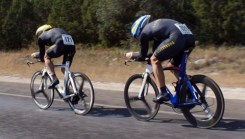
For us the race is a chance for average cyclists to ride among the pros/serious cyclists and feel the excitement of a well-organized race. Compared to the single man race, the two-man is the most fun because you have a teammate with whom you must be in sync and coordinate throughout the race in order to do well. Unlike the long distance endurance rides that I do all year, this race is all about speed and it’s really fun.
This is the third time I’ve done this race, and each time my race partner has been my good friend Robert Parker. Parker is a competitive athlete in both running and cycling. Just two weeks before the Tour de Gruene he ran a 100-mile relay (his portion, 25 miles) through rugged hill country trails. Two weeks after the Tour de Gruene he ran a 50-mile cross country race. With all the running, Parker has had little time to prepare for the Tour de Gruene. Although we did have a chance to do one practice ride on the course (averaged 20.5 mph) the week before the race, and we also did the Leakey Death Ride (193 miles) three weeks before. But, this alone is not enough training to do well in a time trial race.
For myself, I have been doing considerable riding (I don’t run anymore). I mainly rode with my regular group on weekends and once during the weeks. I also rode on my own once a week leading up to the race, doing sprints that simulate the actual race course. Training has been different this year. In the past, I would do only dedicated training on my own starting in October and not ride with the group. This is the best way to improve Time Trial race speed, but I enjoy riding with the group so much that it’s hard to turn down a good group ride.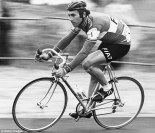
191 teams road in two bike classes – Aero and Merckx (Road Bike). Merckx class is the traditional road bike that we typically see on the streets. It’s named Merckx in honor of Eddy Merckx, a 1960s and 1970s professional cyclist considered to be the “greatest and most successful cyclist of all time” (VeloNews). He too also did the Tour de Gruene time trial race twice back in the 1990s.
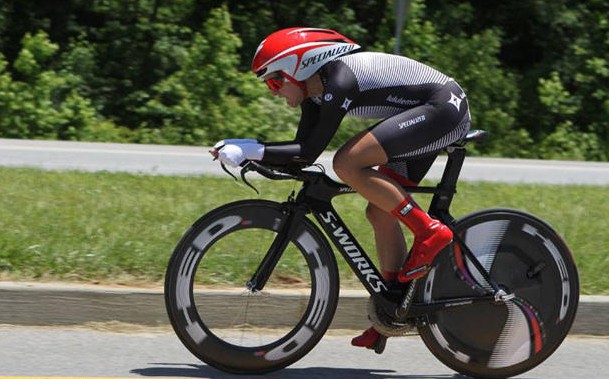 The Areo class consists of the new aerodynamic Time Trial and Tri bikes that you see used in races by pros and serious cyclists willing to spend the money. These bikes provide a significant advantage because they dramatically reduce wind resistance which is the biggest inhibitor to going fast. Robert and I were in the Merckx class.
The Race Course
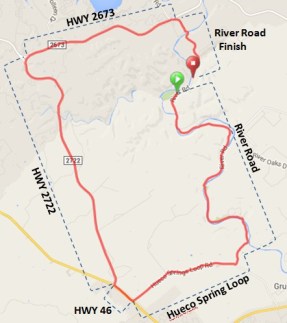
The race course is 26.4 miles long with 1324 ft of climb; according to my data (official website says 1490 ft). This course is tougher than years past because there is more than 250 ft of additional climbing, making it harder to have a fast time. This year’s course can be divided into six segments:
- River Road – 7.4 miles of flat road, opportunity to go fast
- Hueco Spring Loop – 4 miles, start of hills, steep incline
- Hwy 46 – short .7 mile flat segment, chance to go fast and prepare for the long hills
- Hwy 2722 – 8 miles of four good hills
- Hwy 2677 – 4.2 miles downhill, opportunity to go fast again
- River Road Finish – 2.1 miles to finish the race
The Race
November 9th was a great day for a cycling race. Although it was cold, it was very dry with only a slight wind. Each team lined up at the starting gate in race number order and was given the countdown to start riding every 30 seconds. Our team was number 153 with a start time of 8:48:30 a.m. We barely made it to the starting gate on time and therefore got off to a terrible start, as you can see in the video. For the first few seconds I wasted time trying to clip into my pedals instead of grinding the crank to quickly get up to speed.
The River Road section of the race is just over seven miles of flat road before hitting the hills. This is where we needed to go our fastest and raise our average speed. Having a tight pace line is important during this section because we hit speeds from 18mph to 34mph causing wind resistance to be a factor. We each led (pulled) the pace line for a few minutes while the other drafted behind, rested and then switched positions. Here is another video as we rounded the corner from the start. Here you can see that we picked up speed and got into a good pace line position to draft behind each other. At that point we were averaging 25mph.
About three quarters of the way down River Road, we passed our first team of riders (the team that started 30 seconds before us). Although Parker and I did not say anything to each other, we both had a satisfying feeling that we’d passed other riders. This team was on standard road bikes like us, but we especially enjoy passing Aero bikes teams when given the opportunity.
As we proceeded further down River Road, we rode in perfect harmony, although at one point Parker asked me to slow down. Normally it’s me that must ask Parker to slow down, but this year he just did not have the time to train. I repeat, normally it’s me that can’t keep up to Parker.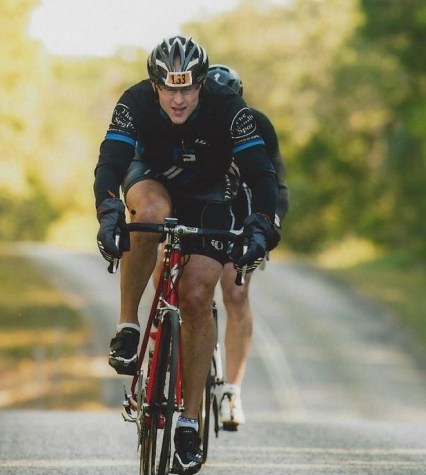
By the time we ended the River Road segment, we had averaged 23.2 mph, a very good pace and almost two miles per hour faster than our practice run the week before. This marker is important because the end of race speed should be approximately one mile per hour slower, based on the practice run. On the practice ride our pace was 21.3 mph along River Road and we ended the course with 20.5 mph (.8 mph difference). This predicted capability held true for other training rides I did, as well. That means we should/could have had a finishing speed of 22+mph for this race. Good news because I’d targeted 21.5 mph for the race; I thought 22 mph was beyond our ability for this course.
From River Road we entered the Hueco Spring Loop segment, and from this point and for the next 12.5 miles, we hit constant hills climbing over 1000 ft. During this segment, we hit the steepest parts, maxing at 9.6%. The pace line does not matter on the hills because our average speed dropped down dramatically on the climbs, but we still averaged 17.5 mph for the whole Hueco Spring Loop (exactly the same pace as our practice run).
Not too far into the Hueco Spring Loop we suddenly and surprisingly were passed by another team. In the past, that would have motivated us to pick up the pace to catch them and get back in front. Not this team though, they were going fast and we had no way of catching them. Then another team passed us a few minutes later. A real downer, two in a row! Considering that this team didn’t have the speed of the other, we picked up the pace, staying fairly close behind, all the while hoping at some point to pass them.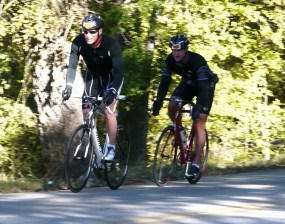
As we crested a hill I had to slow down one more time for Parker. This time he commented about the difficulty in keeping up. A retort was not necessary because I knew Parker would come on strong at the end. And that is exactly what he did. As I slowed down to let Parker catch up, he then passed me and suddenly I had to stomp on the pedals to catch back up to him. I noticed how tired I got and it surprised me. This moment of feeling overly tired will came back to mind when we got into the hills on Hwy 2722.
As we turned on Hwy 46, we had a short .7 mile decline. We should have quickly picked up speed but we averaged for the first half mile only 19mph. Then we did get up to 23mph for the last portion as we turned onto the next highway. Hwy 2722 holds the back side of the race, consisting of an eight mile stretch of four long hill climbs. Our plan was for Parker to take the lead climbing the hills and I would take over on the decline. Parker is usually stronger on the hill climbs, which would enable me to conserve energy so I could take the lead as we crested the hill. From there, I could lead with an aggressive attack of the downhill.
As we started the climbs, I noticed I was not in my natural rhythm and felt the need to go faster; I slowed down to stay behind Parker. By slowing, I assumed I would conserve energy and be less tired at the hilltop, so I could push it hard on the downhill. That tactic didn’t work, because I was still tired at the top; I think this was due to being out of my normal rhythm. Although I tried to pedal hard on the downhill, we just didn’t go as fast as I thought we could. Going downhill should have been easy, but I felt tired on all four hills. It’s the same tired feeling I felt on the Hueco Spring Loop when I had to catch back up to Parker.
On the second hill when I felt especially tired, something unusual happened. My left eye started to blur, as if my glasses had fogged up, but they hadn’t. Although my left eye didn’t hurt, I couldn’t make out any detail with it. Especially bothersome was that I couldn’t see three dimensionally. The blurriness remained for the rest of the race, but I got used to relying on the right eye.
Remember the team that passed us on the later part of Hueco Spring Loop? We had tried to stay close in hopes of later passing them. Well, the further we traveled down 2722, the further and further away they got, until finally they were completely out of sight. I will mention this team again when I analyze the results. Fortunately for our ego, we did pass several other teams that appeared to have a harder time on the hills than we did.
The 2722 segment ended at the top of the fourth hill. As we continued on, I felt we did not go as fast as we should have. It almost felt as if we had a strong wind against us, but we didn’t. Comparing the race with our practice ride, the data proves that we did not do well.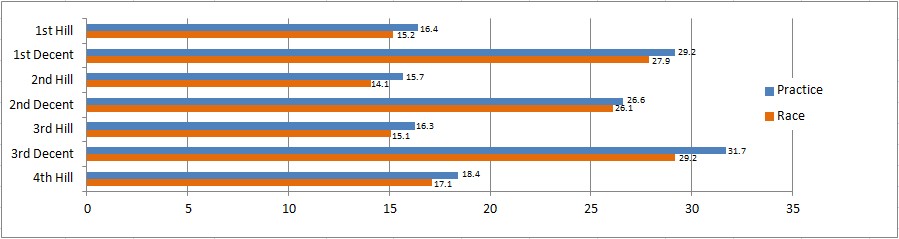
On each of the four hill climbs and descents, we were slower on the race than the practice ride. While I led on the descents, we did hit a top speed of 38.6 mph, but that was still slower than the practice ride that hit 41.1mph. For the whole 2722 segment we averaged 18.4 mph compared to 19.9 mph on the practice ride (1.5 mph is a big difference). That should not have occurred. We rode hard on the practice ride, but not as hard as in the race, which should have culminated in faster times. Although we had a super start on the River Road segment, we lost all that advantage on 2722. As a result, the practice ride turned out to be faster than our race up to this point. Here is a video showing how the two rides compare and you’ll see as we turn the corner off 2722 onto 2673, the practice ride (blue dot) is slightly ahead of our race (gold dot).
Were these thoughts about rhythm worthless rationalization or did we simply push ourselves too hard on River Road, exhausting ourselves as we hit the hills on Hueco Spring Loop and Hwy 2722? If truly exhausted, we would have not been able to do well for the remainder of the race and especially on the next 4.2 mile segment along Hwy 2673.
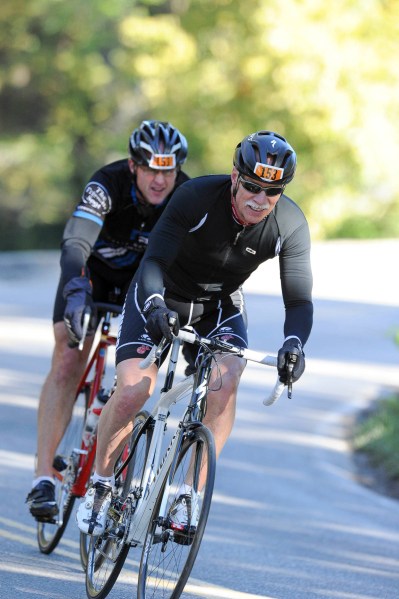
As we headed down Hwy 2673, we picked up the pace going much faster and with greater ease, as Parker and I traded off the lead. Yes, we still had energy and it felt great. We were back in rhythm and it felt like we were flying through the air. I could see another team about a quarter mile ahead and felt we could chase them down. We pressed hard, but surprisingly were not catching up as fast as I thought we could. Then I noticed they were an Aero bike team. We were on a straight downhill road and Aero bike teams have a clear advantage in that situation because they can glide though the air much faster. As we came to the end of 2673, we kept pushing hard and began closing the gap. We averaged 25.7mph for the 2673 segment (2.7mph faster than the practice ride) proving we did not wear ourselves out on the Hwy 2722 hills.
As we turned the corner back onto River Road for the remaining 2.1 mile finish, we finally passed the Aero bike team. But only a few seconds later, they passed us. We then turned on the gas and passed them again; I thought for sure they’d pass us again, but that didn’t happen. Parker told me later that he saw that they were “out of gas.” As we got to what we thought was the last mile, I expected Parker to take off and quickly pass me for the final sprint. Indeed he did and he took off, which caused me to go faster to stay right on his tail.
We suddenly and surprisingly came to the finish line much faster than expected. We both thought the finish to be further down the road. Parker told me later that he would have started his “patented sprint” sooner, if he knew the finish line was so close. That miscalculation on our part cost us valuable time, because Parker is really fast on the final sprints.
Race Results and Analysis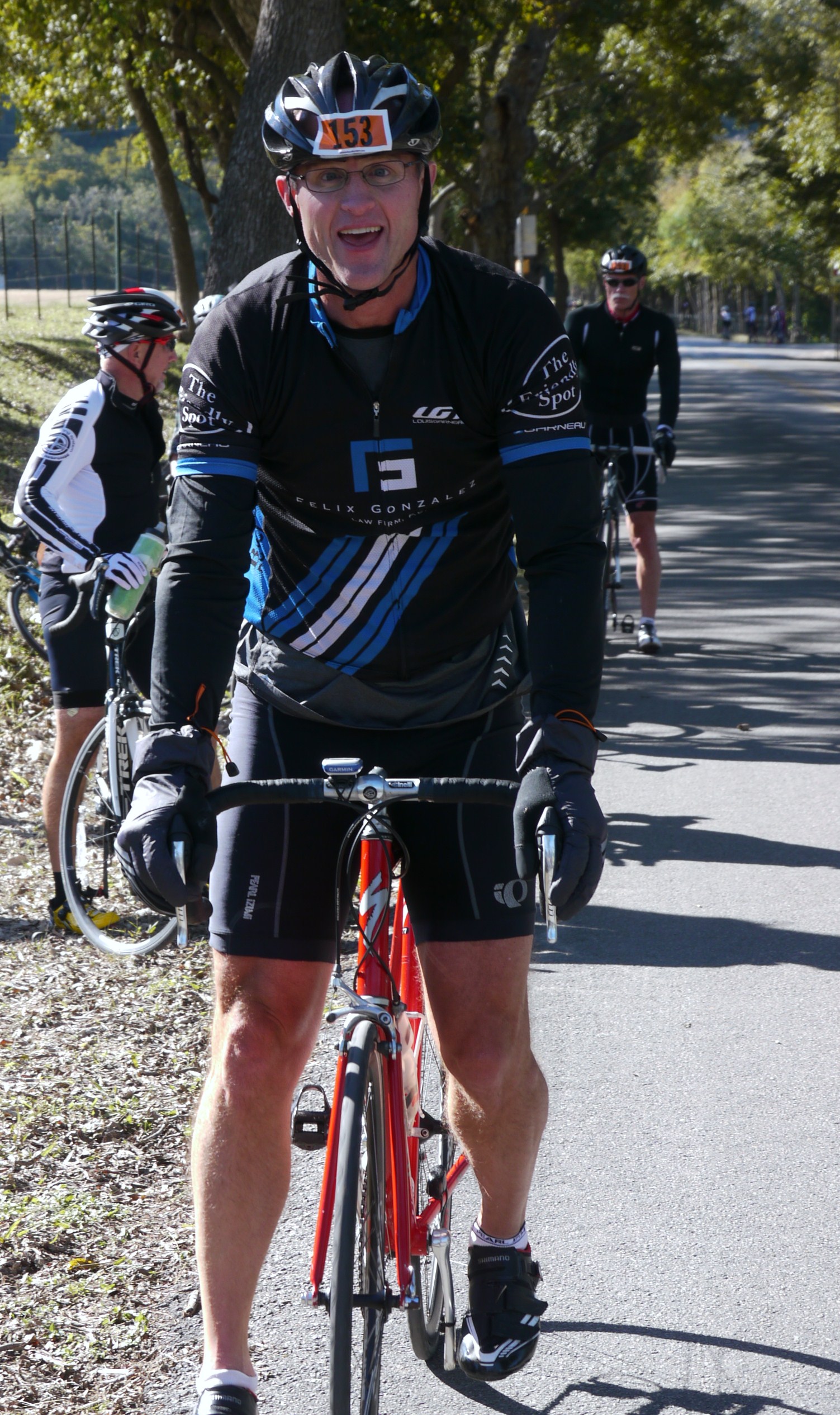
In the end, we finished with an average speed of 20.9 mph (1:15:50 time), only .4mph faster than our practice ride. With that we still took 3rd place in our age group and 16th out of 54 all men teams in the Merckx class (road bike). Out of 191 total teams, we took 84th (men and women in the both the Merckx and the Aero class). This included all the serious cyclists and pro riders, as well. The winning time for the entire race was 28.1 mph won by John Korioth and Brandt Speed. John Korioth is a friend and riding partner of Lance Armstrong, as well as past winner of the USA Cycling Masters National Championship.
If we had reduced our time by only 23 seconds, we would have achieved the 21mph mark. That was easily doable because we got such a slow start. Plus, we miscalculated the finish for Parker’s sprint. If we cut two minutes off our time, we would have achieved the targeted 21.5mph. All we needed to do was match our practice run pace on the 2722 segment (which was exactly two minutes faster than our race time), and our race speed would have been 21.5 mph. That means 21.5mph was truly achievable for us, not a stretch goal. It is interesting to note the team that passed us on Hueco Spring Loop that we tried to keep pace ended up with 21.5mph. We should have been able to keep pace with them and beat them in the end.
In order for us to have taken 2nd or 1st in our age group, we would have had to knock off five plus minutes of our time, because the top two places in our age group was 22.1 mph and 22.2 mph. That speed was not within our reach this year. The winner of all Merckx class (road bikes) had a speed of 23.9mph. That is fast on a road bike. These guys are out of our league and part of a highly competitive USA Cycling racing team.
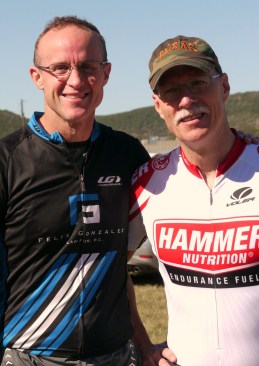
Although we did not hit the targeted 21.5 mph, I am (we are) still pleased with what we did for one simple reason: that race was fun! Different from cycling in an endurance ride or running a marathon, or even an individual sprint race, this race requires two people to work closely together. When that’s done well, it is so much fun. Parker is a great Time Trial racing partner; we work well together. So it matters not that other cyclists are faster than us, because no one had more fun than us!
After the race Parker said, “Next year: 22,” That’s Parker’s competitiveness!
22mph won’t be easy.
 Bull on a Bike